
Income Tax Proposal, Levy Support, and Questions…
The Union City Council meeting recap from April 13, 2026, revealed several important issues. These ranged from meeting procedures to financial planning decisions that may affect residents in the coming years.
A First: Required Sign-In for All Attendees
At this meeting, every person in the room had to sign in. This applied to all attendees—not just those planning to speak.
As a result, the process felt more structured. It also created a clear record of who attended.
In addition, four high school students were present. They attended to earn Government class credit. This was a great example of connecting classroom learning to real community involvement.
Clarifying How Meeting Minutes Are Recorded
Before regular business began, the Law Director explained how the City should handle meeting minutes.
He referenced:
- State and local law
- Robert’s Rules of Order
- The City Charter
First, he clarified that the City must record meetings. However, the law does not dictate how to do so.
For example, the City may use:
- written summaries
- audio recordings
- video recordings
He also made another key point. Meeting minutes should not serve as transcripts. Instead, they should summarize official actions.
This discussion followed a prior meeting where the Clerk produced 28 pages of notes. Because of that, Council raised concerns about time and efficiency.
As a result, Council voted to move forward with summary-style minutes.
At the same time, members discussed future options. For instance, they may explore audio or video access for the public. Many other communities already provide this.
Financial Items and Legislative Actions
Several key financial and policy items were addressed during the meeting:
✔ Street Levy Renewal
Council declared support for a five-year, three-mill renewal levy, with no increase in the tax rate, beginning in 2027.
✔ Proposed 1% Income Tax (NEW)
Council also supported moving forward with a proposed 1% municipal income tax, effective January 1, 2027 (pending voter approval).
The stated purpose includes:
- Police and Fire operations
- Equipment maintenance and replacement
- Debt service on future investments
✔ Commitment to Residents (Resolution 26-05)
One of the Council also made a clear commitment to residents.
If voters approve the 1% income tax:
- City property taxes will NOT increase
- This commitment will last for 10 years
Council presented this as a way to protect homeowners while maintaining funding for essential services.
In addition, they emphasized that levies remain stable unless voters approve changes.
Additional Actions and Observations
Other items included:
- Authorization to sell city-owned real estate
- City services tied to proposed annexation from Butler Township (pending County approval)
- A 7-year street lighting agreement with a 5.5% increase to ensure continued service
- Continued discussion around making audio/video recordings available to the public
Meeting Frequency and Accessibility
At the end of the meeting, Council voted to cancel the April 27 session.
This is not the first time this has happened. In fact, fourth Monday meetings are often canceled.
Because of that, a practical question comes up:
👉 Would one consistent monthly meeting serve residents better?
For example, the City could hold one regular meeting each month. Then, it could schedule special meetings only when needed.
This approach would give residents a clearer expectation of when to attend.
Final Thoughts
Overall, this meeting highlighted several important themes.
First, it showed how the City is working to improve efficiency.
Next, it demonstrated a proactive approach to financial planning.
Finally, it raised important questions about future revenue.
Most importantly, it reinforced one key idea:
👉 Showing up matters.
Because when residents understand the details—and ask the right questions—they can make informed decisions about their community.s—is what allows residents to make informed decisions about their community.
🔥 A Key Financial Question
As I listened to this discussion, one point stood out to me.
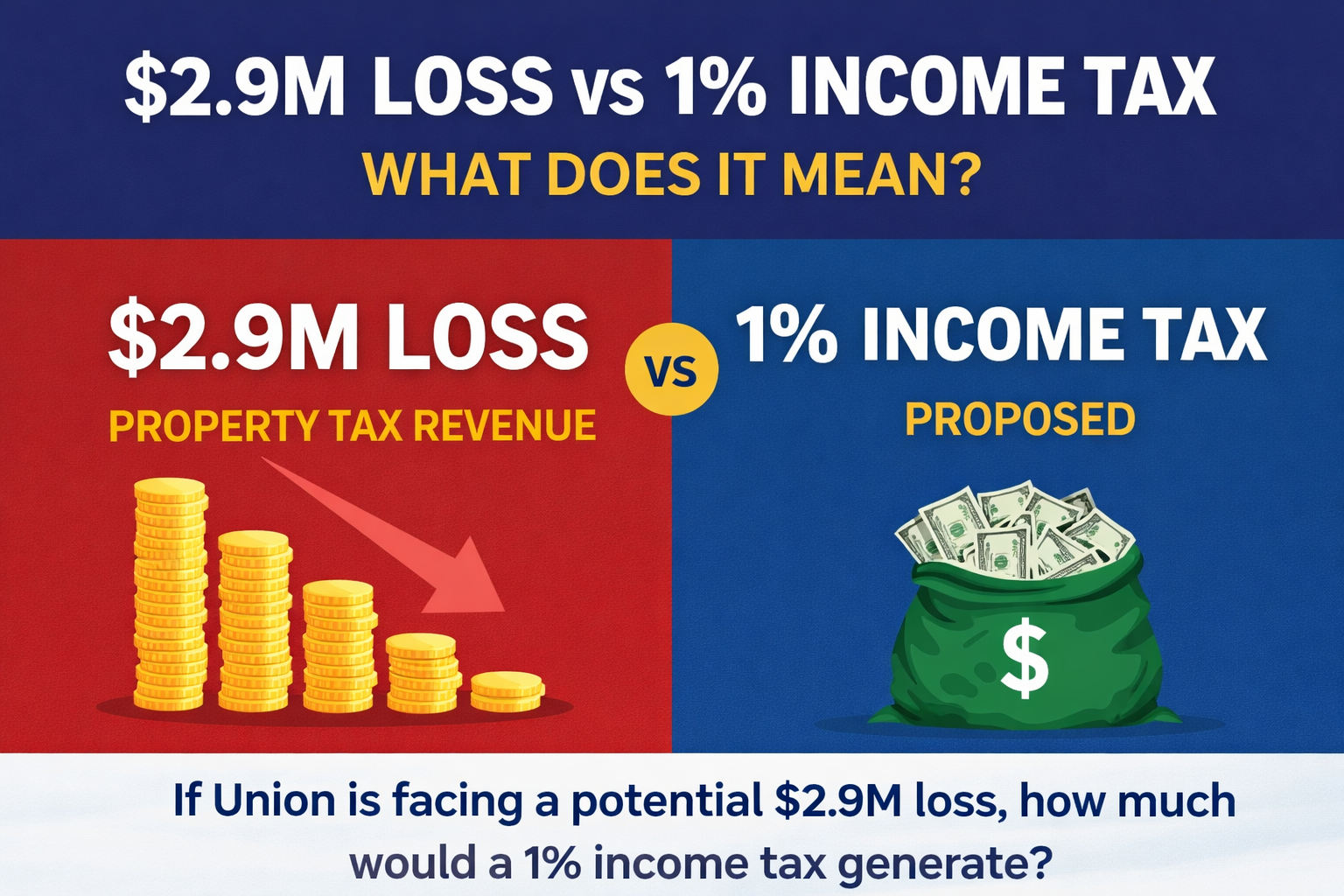
Council referenced a potential loss of approximately:
👉 $2.9 million in property tax revenue
That immediately led me to a question I believe residents should also be asking:
👉 How much revenue is a 1% income tax expected to generate?
At this meeting, no clear public estimate was provided.
Because of that, residents do not yet have a full picture. Without a projected revenue number, it becomes difficult to compare the proposed income tax to the potential loss being discussed.
That gap matters.
If we want to make informed decisions, we need to understand both sides of the equation—what could be lost and what is expected to be gained.
More importantly, this may not stop with one community.
If this approach moves forward, other communities could follow. In many cases, that could result in more revenue flowing into local budgets.
For that reason, now is the time to ask questions, review the data, and understand how these decisions could affect you directly.