
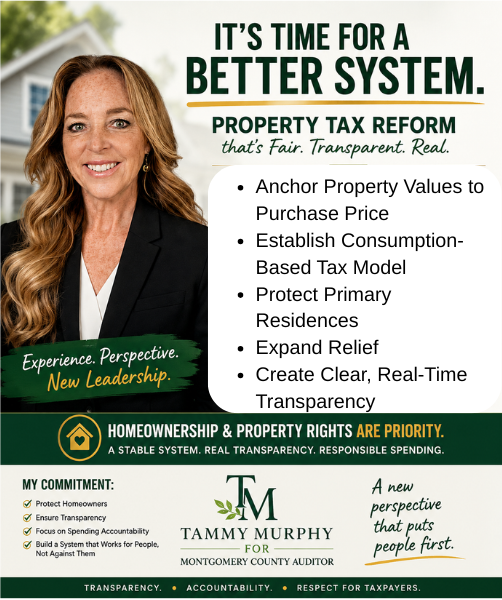
A Better Way Forward for Homeowners
Over the past few weeks, months, and even years, I have listened to growing concerns about property taxes. My property tax reform approach comes directly from those conversations—because the frustration people are feeling is real, consistent, and cannot be ignored. IF the New Governor does not Dismantle the Property Tax System nor the Abolish Property Tax Initiative is PASSED…then we need a NEW APPROACH!
When the same concerns continue to surface across communities, it is not isolated. It is a signal.
If the current approach were working, we would not be seeing this level of frustration from the very people the system is supposed to serve.
So the conversation must shift—from reacting to the problem, to clearly defining a better path forward.
Where the System Falls Short
This issue is not just about cost.
It is about how the system operates—and who it ultimately serves.
Today, property taxes are driven by:
- fluctuating assessed values
- limited transparency in how those values are determined
- and a structure that creates financial pressure without warning
As a result, homeowners are often left reacting instead of planning.
And over time, that erodes trust.
Homeownership and Property Rights Must Come First
Before any policy discussion begins, one principle must be clear:
Homeownership and property rights are the priority.
Revenue generation for municipalities should never come at the expense of the people who live in, invest in, and maintain our communities.
Because when people can no longer afford to stay in their homes, the system is no longer working as intended.
A Property Tax Reform Approach Built on Structure, Not Patches
If voters—and future leadership—choose to abolish the current property tax system, then the conversation must immediately shift to one critical question:
How do we create a stable, reliable source of revenue for municipalities that does not place ongoing financial pressure on homeowners?
That is where a structured, long-term approach becomes necessary.
1. Anchor Property Values to Purchase Price
If the current system remains in place, or during any transition, property values should reflect the actual purchase price at the time of sale.
This creates:
- predictability for homeowners
- stability in taxation
- alignment with real market activity
It also eliminates the cycle of repeated reappraisals that increase tax burden without a transaction.
2. Establish a Consumption-Based Tax Model
If we move beyond the current structure, then the focus should shift to a consumption-based system.
This means:
- taxes are applied at the time of purchase or sale
- value is based on real transactions—not estimated increases
- long-term homeowners are no longer penalized for staying in place
In this model, taxation becomes tied to activity—not ownership.
3. Protect Primary Residences
Primary homeowners are the foundation of strong communities.
They live there; invest there and maintain and improve their homes.
Because of that, they should be protected.
A clear approach would include:
- reducing assessed value by 50% for primary residences
- removing income-based limitations
- ensuring that if it is your home—you benefit
This creates fairness while reinforcing community stability.
4. Expand Relief if the Current System Remains
If the current structure stays in place, additional protections must still be considered.
That includes:
- removing restrictive income caps
- expanding eligibility for relief programs
- recognizing that financial pressure does not follow strict thresholds
This ensures that support reflects real-world conditions.
5. Create Clear, Real-Time Transparency
No system can function effectively without transparency.
Homeowners should be able to:
- understand how their property is valued
- see how taxes are calculated
- access information before changes occur
Clarity builds trust.
And trust is currently missing for many.
6. Shift from Penalties to Practical Solutions
When financial challenges arise, the system should not make them worse.
Instead, it should provide solutions.
That means:
- reducing reliance on high-interest penalties
- offering manageable payment options
- prioritizing keeping people in their homes
A system designed to serve people should not push them out.
Auditor Oversight Must Focus on Spending and Accountability
Property tax reform is only one part of the equation.
Oversight matters just as much.
The role of the Auditor should include:
- reviewing and ensuring budget accuracy
- limiting unnecessary mid-year adjustments
- evaluating spending before asking for more revenue
- prioritizing taxpayer impact in every financial decision
In addition, county asset growth and investments should come after taxpayers are served—not before.
Because government should operate with the same discipline expected of the people funding it.
Why This Property Tax Reform Approach Matters
This is not just about policy.
It is about whether:
- people can afford to stay in their homes
- homeownership still represents stability
- the system reflects fairness and predictability
Right now, too many people are questioning those answers.
From Reaction to Real Reform
For too long, the system has relied on adjustments and temporary fixes.
However, those efforts have not addressed the root issue.
So the path forward must change.
From managing the symptoms to restructuring the system itself.
My Commitment
I am not stepping forward to maintain what is not working.
I am stepping forward to improve it.
With:
- transparency people can see
- accountability people can trust
- and a structure that prioritizes homeowners first
Closing
In real estate, value is not a guess.
It is determined through a structured process—comparable sales, condition, financing requirements, and market validation.
In fact, two homes on the same street can have very different values depending on updates, condition, and buyer demand.
That level of accuracy is required in every real estate transaction.
When a buyer is financing a home, the lender requires a neutral third-party licensed appraiser to physically visit the property, evaluate its condition, and determine value based on real, verified data.
That process exists to protect everyone involved.
Yet homeowners are often taxed based on mass appraisal models—broad algorithms that estimate value without ever stepping inside the home.
That disconnect matters.
Because when valuation lacks precision, taxation loses fairness.
We already have a system that determines property value every day—through real transactions, verified data, and professional oversight.
The question is—why aren’t we using it?
It’s time to align how property is valued with how property is actually bought and sold.
Because protecting homeownership and property rights isn’t optional.
It’s the priority.