
When “Paper Gains” Don’t Match Real Life
Property tax reform in Montgomery County has never been more urgent—especially as new reappraisal numbers highlight a growing disconnect between rising property values on paper and the reality in our neighborhoods.
According to recent reporting, residential property values increased 19% in just one year, with an overall $7 billion increase across the county.
On paper, that sounds like growth.
However, for many residents, it does not feel that way.
The Billion-Dollar Question in Dayton
One of the most striking figures is this:
👉 The City of Dayton alone saw over $1 billion in increased property value.
At first glance, that suggests major progress.
But when you look closer, a different reality emerges.
Across many Dayton neighborhoods, residents still see:
- Abandoned and blighted homes
- Limited reinvestment in infrastructure
- A lack of thriving commercial corridors or “Main Street” development
In other words, the lived experience does not match the reported value increase.
When Higher Prices Don’t Mean Stronger Communities
Yes, some homes that once sold for under $100,000 are now being listed at higher prices.
However, that does not tell the full story.
Dayton also continues to experience:
- Higher levels of housing inventory
- A greater number of unsold properties
- Slower market movement compared to surrounding communities
This means properties are not moving at the same pace, even as values rise.
As a result, higher valuations do not always reflect stronger demand or healthier neighborhoods.
The Affordability Pressure Is Real
Affordability remains a growing concern across Montgomery County—but it is especially critical in Dayton.
When property values increase rapidly:
- Tax burdens can increase
- Housing stability becomes more fragile
- Long-term homeowners face greater financial pressure
At the same time, these increases occur regardless of whether a homeowner has actually realized any financial gain.
The Disconnect: Paper Value vs Real Impact
This is where the system breaks down.
Property values are rising based on:
- Recent sales activity
- Market modeling
- County-wide adjustments
However, those increases are applied broadly—even to homeowners who:
- Have not sold
- Have not refinanced
- Have not benefited financially
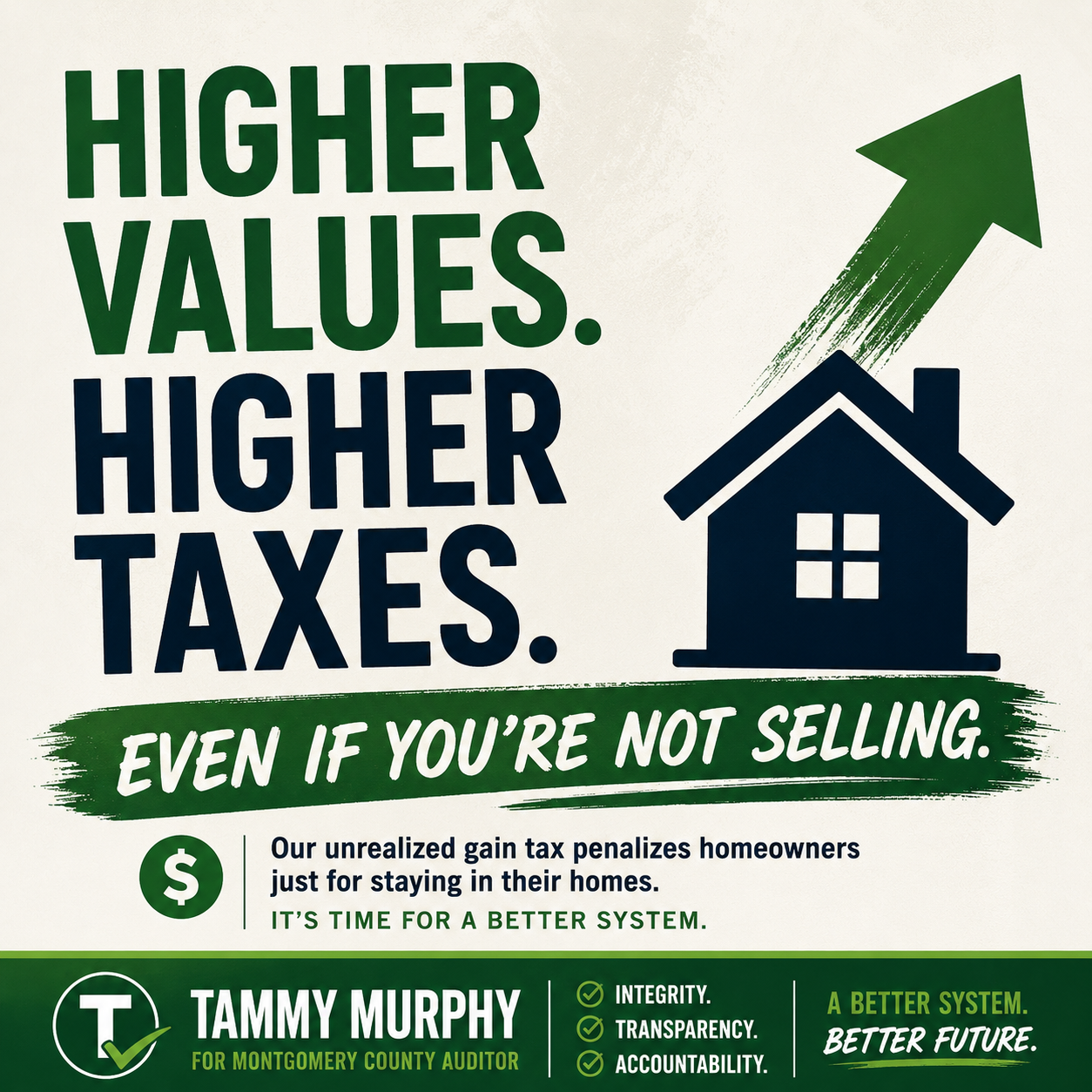
As a result, homeowners are being taxed based on potential equity, not actual income or realized gain.
Reappraisal Without Reform Leads to the Same Outcome
The current reappraisal cycle is already underway.
While officials note that value increases do not directly equal tax increases, the reality is more complex.
When values rise across a majority of properties—as estimated in the current cycle—the pressure on tax bills follows.
Therefore, without meaningful reform, the outcome remains predictable:
- Higher values
- Increased tax burden
- Continued strain on homeowners
This pattern is not new. It is a continuation of the same system.
Temporary Relief vs Long-Term Reality
Programs like expanded Homestead exemptions are often presented as solutions.
While they may provide limited relief, they do not address the underlying issue.
Instead:
- Relief is temporary
- Value increases continue
- The system remains unchanged
As a result, homeowners are left navigating short-term assistance while facing long-term increases.
It’s Time to Address the Reality
Montgomery County residents understand what is happening in their neighborhoods.
They see:
- Which homes are selling—and which are not
- Which areas are improving—and which are struggling
- The difference between real investment and paper value
The current system does not fully reflect that reality.
A Better Approach to Property Tax Reform in Montgomery County
Real reform must start with a simple principle:
👉 Homeowners should not be penalized based on unrealized gains.
Instead, the system should:
- Reflect accurate, localized conditions
- Align values with real market activity—not assumptions
- Protect homeowners from unpredictable increases
- Provide transparency in how valuations are determined
Moving Forward
The conversation around property taxes is not just about numbers.
It is about fairness.
It is about accountability.
And most importantly, it is about ensuring that homeowners are not burdened by a system that does not reflect the reality of their communities.
Enough is enough.
It’s time to move beyond the status quo and bring forward a system that truly works for the people it is meant to serve.