
Why Auditor System Accuracy Matters
When Property Records Don’t Match Reality
Property records accuracy should be the foundation of a fair tax system.
However, recent conversations with a local neighborhood association revealed something concerning: the system doesn’t always reflect what’s actually happening in real life.
Even more concerning—when residents report issues, they often don’t receive answers.
That’s where the real problem begins.
What Residents Are Seeing Firsthand
As a follow-up to the Fairview neighborhood association meeting in Dayton that I attended a few weeks ago, I had several email exchanges today with residents.
Here are the types of issues identified:
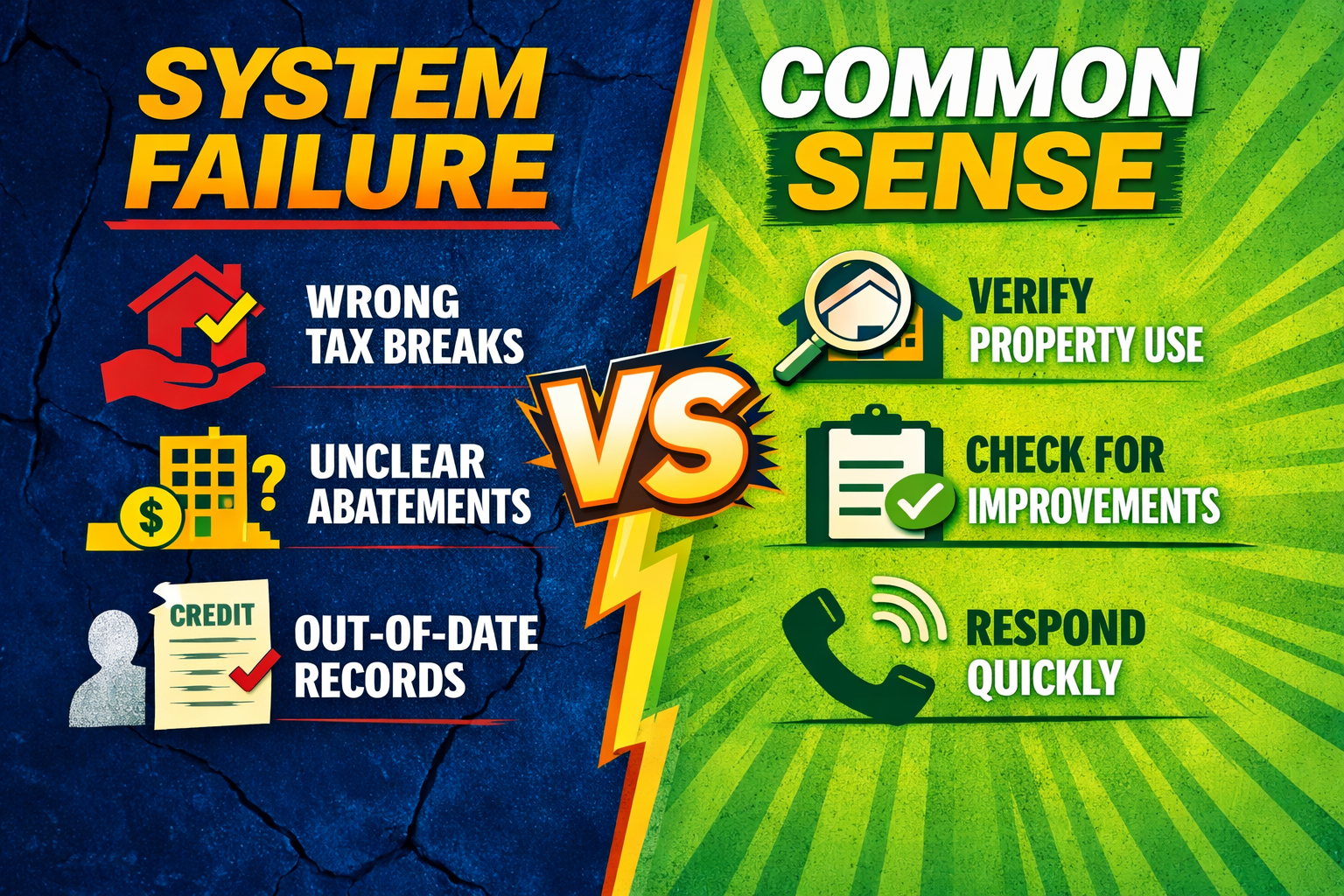
Owner Occupancy Credits Applied Incorrectly
Some properties appeared to be receiving owner-occupancy tax reductions—even though they were clearly rental properties or vacant.
In reviewing these cases, simple inconsistencies stood out:
- Mailing addresses did not match the property location
- The same owner appeared tied to multiple properties claiming the credit
- Some homes were visibly vacant or registered as rentals
These are not complex investigations.
They are basic checks that should be part of a reliable system.
Tax Abatements Without Clear Justification
In another case, a property that had transitioned from a tax-exempt entity to private ownership appeared to still benefit from tax advantages.
Questions that should have clear answers did not:
- Was a tax abatement formally approved?
- Were improvements completed to justify the incentive?
- Is there documentation supporting the tax treatment?
When incentives are applied without transparency or verification, it creates confusion—and raises concerns about fairness.
Delays That Don’t Reflect Real Life
Another issue highlighted a timing gap that affects accuracy.
A property continued receiving benefits after circumstances had clearly changed.
While this may be tied to standard tax cycle delays, it highlights a larger issue:
Life happens in real time—but the system doesn’t always keep up.
Where the System Is Falling Short
These examples all point to the same core issue:
A lack of real-time responsiveness and built-in verification.
A strong system should:
- Automatically flag inconsistencies
- Cross-check ownership, occupancy, and registration data
- Respond quickly when residents report concerns
- Apply corrections without unnecessary delays
Right now, those safeguards appear inconsistent—or missing altogether.
A Better Way Forward
This isn’t about criticism—it’s about solutions.
Based on these real-world examples, there are clear opportunities to improve:
✔ Smarter Verification Systems
Basic data checks—like matching mailing address to property use—should be automatic.
✔ One-Property Rule Enforcement
Owner-occupancy credits should be limited and monitored across all properties tied to an owner.
✔ Transparency in Tax Incentives
If abatements are granted, there should be clear documentation tied to measurable improvements.
✔ Real-Time Reporting and Corrections
Residents should be able to report issues when they happen—and see timely action.
✔ Open Communication
When concerns are raised, responses should be clear, timely, and accessible.
Why This Matters to Every Taxpayer
Accurate property records aren’t just administrative—they directly impact:
- Property tax fairness
- Community trust
- Local funding accuracy
- Confidence in government systems
When the data is wrong, the outcomes are wrong.
Moving Forward Together
What stood out most in these conversations wasn’t just the issues—it was the willingness of residents to speak up.
And that matters.
Because better systems don’t start with technology.
They start with listening.
I will continue showing up, asking questions, and digging into concerns—because understanding what residents are seeing is the first step toward building something better.