
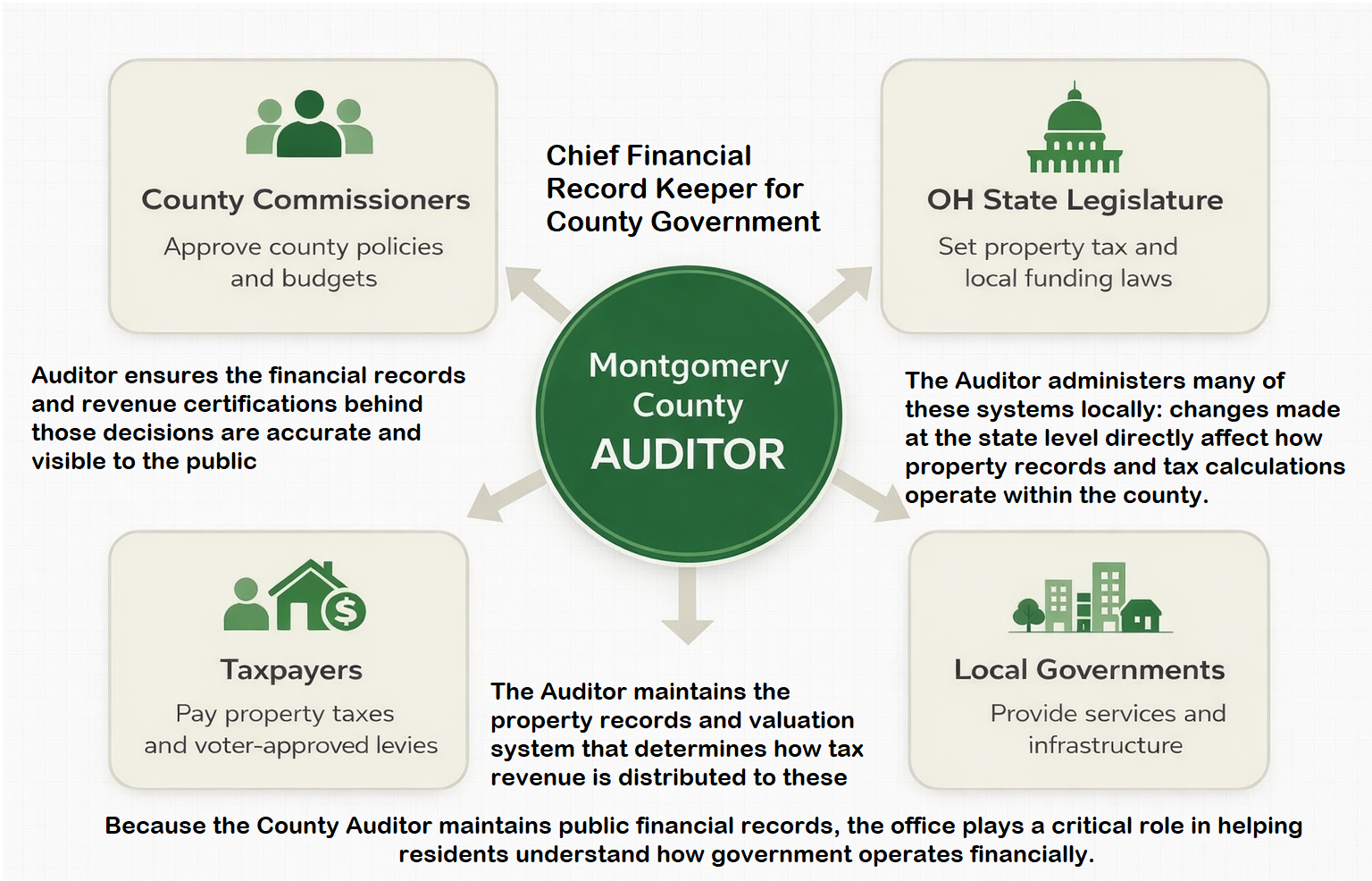
Montgomery County Auditor property taxes affect homeowners long before a bill ever arrives in the mailbox. While most people only think about property taxes when the payment is due, the process that determines those taxes begins months — and sometimes years — earlier.
The County Auditor plays a central role in that process. From determining property values to maintaining public records, the Auditor’s office ensures that the system used to calculate property taxes remains accurate, transparent, and consistent.
Understanding how the Montgomery County Auditor impacts property taxes helps residents better navigate the system and ask informed questions when something does not seem right.
What the County Auditor Does — and Does Not Do
One of the most common misconceptions about property taxes involves who actually sets tax rates.
The County Auditor does not set property tax rates.
Tax rates are determined by:
- Voter-approved levies
- School districts
- Municipal governments
- Township governments
- Other local taxing authorities
Instead, the Auditor’s office performs the critical administrative work that ensures the property tax system operates fairly.
That work includes determining property values, maintaining ownership records, and applying tax credits and exemptions properly.
How the Montgomery County Auditor Impacts Property Taxes
Several key responsibilities within the Auditor’s office directly affect property owners.
Property Valuation and Reappraisal
The Auditor establishes property values during appraisal and reappraisal cycles. These values reflect estimated market value and serve as the foundation for property tax calculations.
Accurate valuation is essential because it determines how the tax burden is distributed across all properties in the county.
Assessment Transparency
Property values sometimes change due to market shifts, neighborhood improvements, or new development.
The Auditor’s office must clearly explain why those changes occur. When residents understand how assessments work, they are better prepared to review their own property information and ask questions if something appears inaccurate.
Transparent communication helps prevent confusion and builds trust in the system.
Tax Roll Accuracy
Once property values are established, the Auditor prepares the official tax duplicate, also known as the tax roll.
This process includes applying:
- Homestead exemptions
- Owner-occupancy credits
- Agricultural classifications
- Other statutory tax adjustments
If these items are applied incorrectly, property owners may pay more than they should. Maintaining accurate tax rolls protects taxpayers and ensures fairness across the system.
Public Access to Records
The Auditor’s office also serves as a primary source for property records and financial transparency.
Residents should be able to easily access:
- Property ownership records
- Valuation history
- Parcel information
- Tax calculation details
Public access to records allows citizens to review information, verify data, and raise concerns when necessary.
You can learn more about how these systems interact with local government in Understanding Montgomery County Ohio Local Government.
Why Transparency Matters
When property assessments appear confusing or inconsistent, trust in the system can erode quickly. Residents may feel uncertain about how decisions are made or whether information is being applied fairly.
Clear communication and accessible records help prevent that uncertainty.
A well-run Auditor’s office focuses not only on accurate data but also on ensuring residents understand how the process works.
Transparency strengthens confidence in local government and allows property owners to advocate for themselves when needed.
The Goal: Accuracy, Clarity, and Accountability
Property taxes are an important source of funding for schools, public safety, infrastructure, and community services. Because these systems affect every property owner, the process must remain accurate and understandable.
The role of the Montgomery County Auditor is not to increase taxes, but to ensure the system used to calculate them remains:
- Accurate
- Consistent
- Transparent
- Accessible to the public
When those principles guide the office, residents gain confidence that the property tax system is operating fairly.