
What Happened to $276 Million Over Budget?
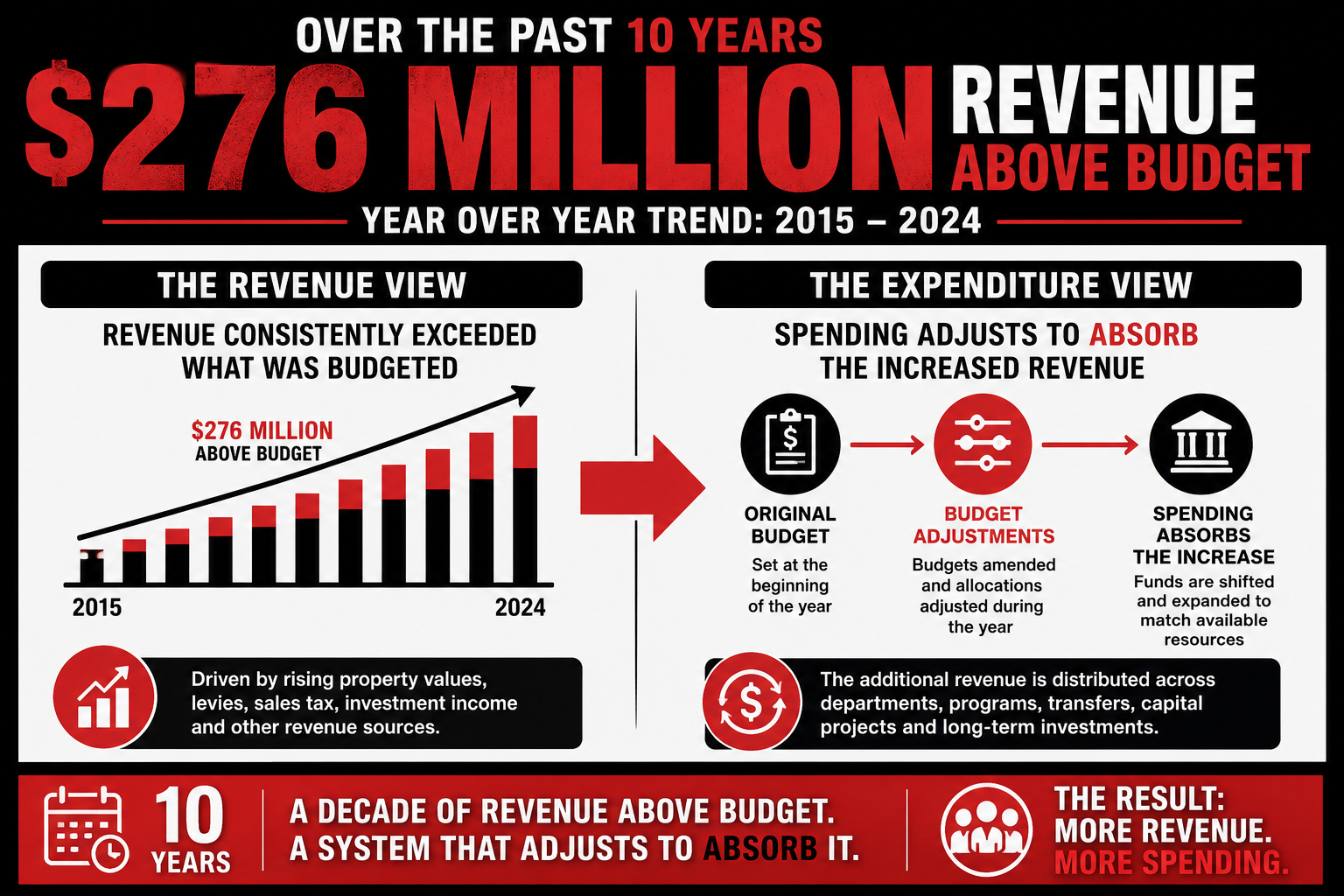
Over the past 10 years, Montgomery County collected more than $276 million above what was originally budgeted.
That finding raised an obvious question:
Where did that money go?
To answer that, we didn’t rely on assumptions. We reviewed the County’s own financial reports—year by year—to understand both revenue and spending patterns.
What we found tells a clear story.
Step One: Revenue Consistently Exceeded Expectations
Each year, the County sets a budget based on projected revenue.
However, actual revenue repeatedly came in higher than those projections.
That increase was driven by several factors:
- Rising property values through reappraisals
- Voter-approved levies over time
- Increased sales tax revenue
- Growth in investment income and other sources
Individually, each source may seem reasonable. Over time, however, they added up to a significant total:
More than $276 million above budget over a 10-year period
Step Two: Spending Adjusted to Match Revenue
The next step was to examine spending.
At first glance, the County appears to stay within its budget each year. However, a closer look reveals something important.
Budgets do not remain fixed throughout the year.
Instead:
- Budgets are amended
- Allocations are adjusted
- Funds are transferred between categories
As additional revenue becomes available, spending authority increases.
This means the comparison is not simply:
Budget vs. Actual
It is:
Original Budget → Adjusted Budget → Actual Spending
The Key Insight
When viewed this way, a pattern emerges:
Spending does not exceed the budget.
The budget expands to accommodate the spending.
Step Three: The Money Is Absorbed Across the System
Because of these adjustments, the additional revenue does not appear in one clear location.
Instead, it is distributed across multiple areas, including:
- General government operations
- Public safety and law enforcement
- Social services programs
- Economic and community development
- Transfers between funds
- Capital projects and long-term investments
This makes it difficult to point to a single line item and say, “this is where the extra $276 million went.”
However, when viewed collectively, the outcome is clear:
The system absorbed the additional revenue over time
Step Four: Financial Position Continued to Grow
At the same time that revenue exceeded expectations and spending adjusted accordingly, the County’s overall financial position strengthened.
Over the same period:
- Fund balances remained strong
- Investment portfolios increased
- Total assets grew significantly
- Net position increased by hundreds of millions
These are all indicators of financial stability.
They also confirm that the additional revenue was not lost—it contributed to a growing financial base.
What This Means
This analysis leads to an important distinction.
The increase in revenue was not solely the result of rising service costs requiring additional funding.
Instead, it reflects a system where:
- Revenue increases through multiple channels
- Budgets adjust throughout the year
- Spending expands to match available resources
A System That Expands
When revenue consistently exceeds expectations, and there is no structural mechanism to reset or rebalance that growth, the result is a system that naturally expands over time.
This is not a one-year occurrence.
It is a pattern observed over a decade.
The Question Moving Forward
Understanding what happened is only the first step.
The next question is just as important:
What should happen when revenue exceeds what was planned?
Should it be:
- Fully absorbed into spending?
- Directed toward long-term reserves?
- Used to offset future financial pressure on residents?
What Comes Next
In the next part of this series, we will look at how the County manages reserves, investments, and financial balances—and whether clear policies exist to guide those decisions.
Because once we understand how the system works, the next step is determining how it should work.