
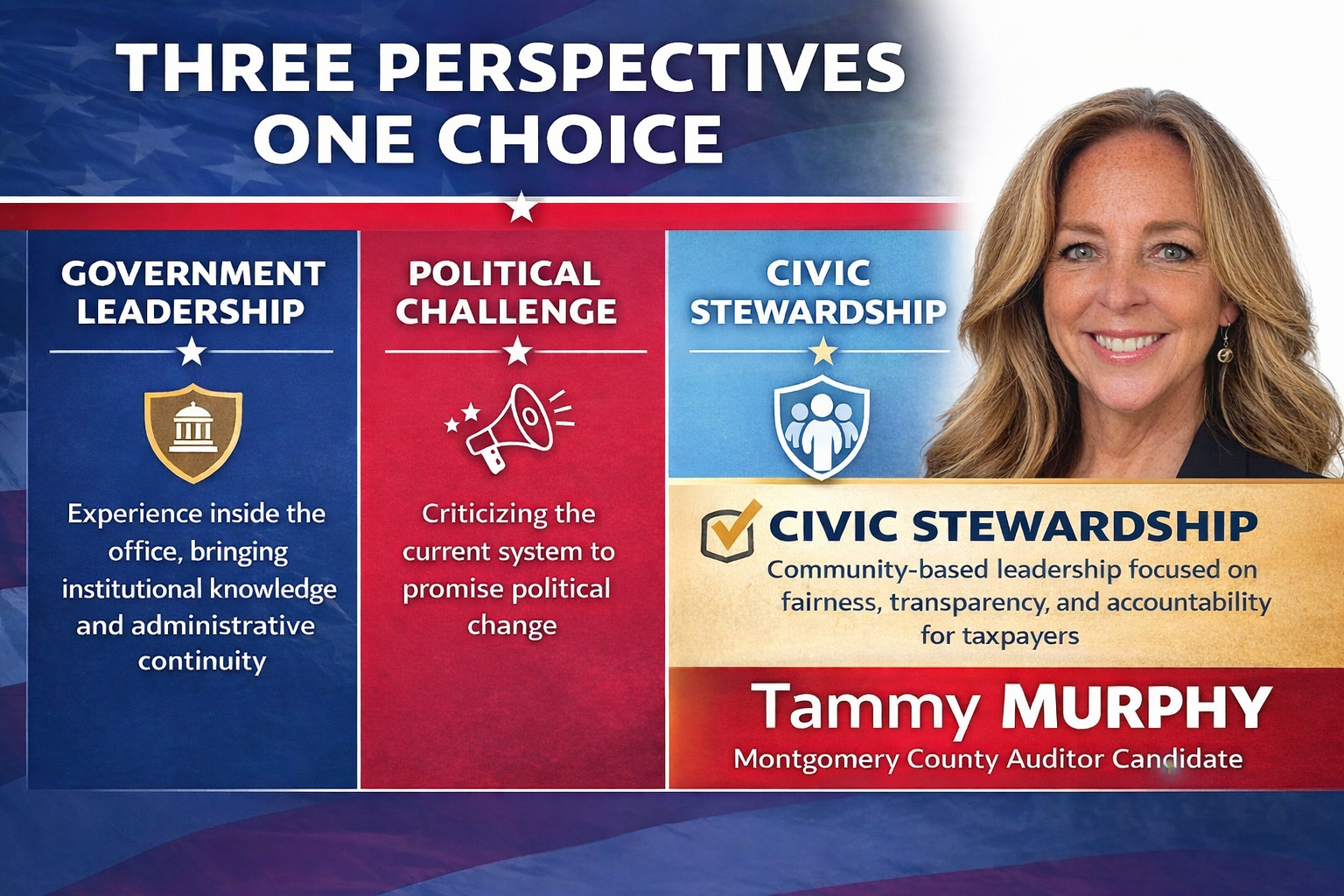
Three Perspectives Voters Should Understand
The role of the Montgomery County Auditor carries significant responsibility. Decisions made in this office directly affect property owners and taxpayers throughout Montgomery County. Because property values influence taxes, household finances, and long-term investments, the leadership approach behind the office matters.
When voters evaluate the Montgomery County Auditor leadership, they often see three different perspectives shaping how candidates approach the job.
Understanding those perspectives helps residents make an informed decision about the future direction of the office.
Government Leadership
One perspective comes from long-term service within government.
Candidates with this background usually emphasize institutional knowledge and administrative experience. Their focus often centers on managing existing programs, maintaining systems already in place, and continuing the operational practices of the office.
Government leadership can provide stability and familiarity with established processes. However, it often reflects a viewpoint developed primarily inside government operations rather than from the experiences of everyday property owners.
Political Challenge
Another perspective approaches the Auditor’s role through a political lens.
Candidates who adopt this viewpoint frequently frame the office around broader policy debates about taxes, economic growth, or political accountability. Their message often centers on criticism of the current system and calls for change.
Political challenge can draw attention to issues within government. However, it often focuses more on political arguments than on the everyday realities residents face when buying, selling, or keeping their homes.
Civic Stewardship
A third perspective focuses first on the residents whose lives are directly affected by property values and taxation.
This approach is best described as civic stewardship.
Civic stewardship begins with a clear understanding that the Montgomery County Auditor leadership must serve every taxpayer and property owner fairly. The office should operate with transparency, accountability, and a commitment to responsible financial oversight.
For more than 25 years as a REALTOR®, I have worked directly with residents navigating property ownership and market changes across Montgomery County. During that time, I have seen how property values influence real households.
Property values affect whether families can purchase their first home. They influence whether longtime residents can afford to remain in their homes. They also shape whether homeowners can age in place while preserving the stability and legacy of their property.
Because of this experience, I view the Auditor’s office through the lens of civic stewardship rather than politics.
Why Civic Stewardship Matters for Montgomery County
The responsibilities of the Montgomery County Auditor leadership extend far beyond administrative duties. The office manages property records, ensures fair valuation, and provides transparency around how local finances operate.
Therefore, the leadership approach guiding the office should focus on several priorities:
Fairness
Property valuations must remain consistent, accurate, and applied fairly across communities.
Transparency
Residents deserve clear and accessible information about property values, assessments, and public financial records.
Modernization
Public systems should use modern tools that make information easier for residents to access and understand.
A Community-Based Perspective
Ultimately, the County Auditor serves the public. Every property owner and taxpayer relies on the office to operate with fairness and responsibility.
A leadership approach rooted in civic stewardship recognizes that property values represent more than numbers on a spreadsheet. They represent families, homes, investments, and the long-term stability of our communities.
For that reason, the leadership of the Montgomery County Auditor’s Office should always reflect a commitment to residents, transparency in public records, and responsible stewardship of taxpayer interests.