
Government Accountability and Ethical Leadership
Government accountability and ethical leadership should be the foundation of every public office. Citizens deserve leaders who operate under the same rules, expectations, and responsibilities as the people they represent.
Public service is not meant to create a privileged class of decision-makers. Instead, it should reflect the same standards of transparency, responsibility, and fairness that citizens experience in their everyday lives.
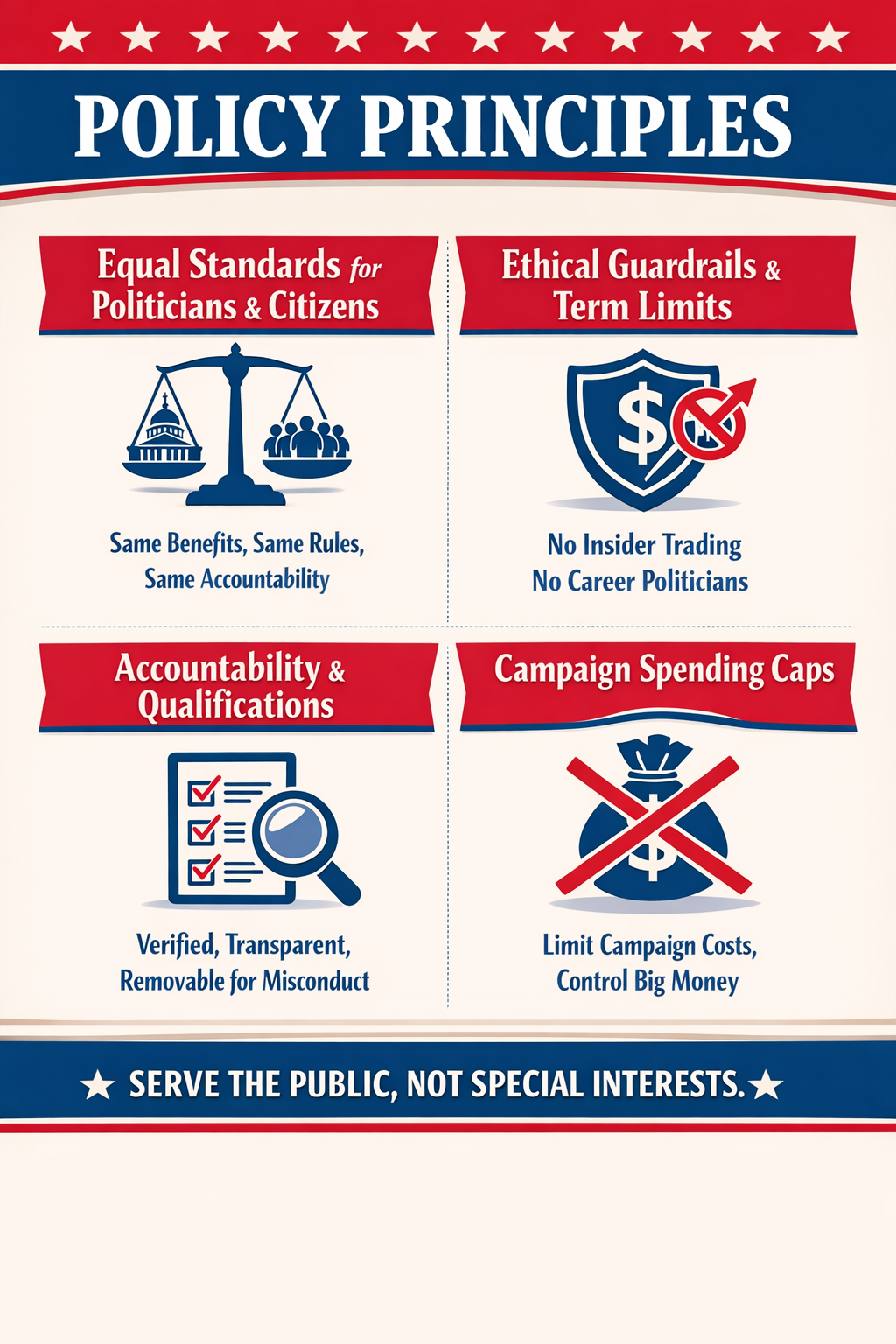
These principles outline what government accountability and ethical leadership should look like in practice.
Equal Standards Support Government Accountability and Ethical Leadership
Those who serve in government should live under the same systems as the people they represent.
That means the same healthcare options, the same retirement systems, and the same workplace expectations that everyday citizens rely on. Public office should not create special advantages or exclusive benefits.
When elected officials experience the same systems as the public, policies become more grounded in reality. As a result, accountability becomes stronger and leadership becomes more responsible.
Ethical Guardrails and Term Limits
Public service should never become a pathway to personal enrichment.
Term limits would help ensure leadership remains fresh and connected to the communities being served. In addition, strong ethical guardrails should prevent the use of insider information for financial gain.
Financial transparency, clear investment restrictions, and oversight of asset growth while in office would help protect public trust and reinforce the idea that elected office is a responsibility—not an opportunity for personal advancement.
Qualifications and Transparency Promote Ethical Leadership
Citizens deserve to know that candidates seeking office meet clear and verified standards.
Basic background reviews, financial disclosures, and verification of qualifications should occur before candidates appear on the ballot. Voters should not have to guess about the credibility or experience of those asking for their trust.
Equally important is accountability once elected. If officials violate the law or abuse public trust, consequences must be clear and enforced.
Strong systems of transparency help ensure government accountability and ethical leadership remain the expectation, not the exception.
Responsible Campaign Spending
The cost of running for office has increased dramatically, often limiting who can realistically seek leadership roles.
Reasonable campaign spending caps and stronger transparency standards would help create a fairer environment for candidates while reducing the influence of excessive financial pressure in elections.
If we expect leaders to manage public budgets responsibly, then the process of running for office should reflect the same principles of fiscal discipline and accountability.
A Simple Standard for Ethical Leadership
Government works best when the rules are the same for everyone.
Public officials should operate under the same expectations of accountability, transparency, and responsibility that citizens live with every day.
Leadership should never be about privilege. It should be about service.
Public office should never come with better rules than the ones citizens live under every day.
A Note from Tammy
Recently, another candidate running for Congress in Ohio’s 10th District, David Esrati, asked how I would approach the responsibilities of serving in Congress.
David and I have actually known each other for many years. I first met him while taking a WordPress training class when I was building the online presence for my real estate business. Over the years since, we have crossed paths in various business, community and veteran related conversations.
We don’t always see eye-to-eye on every issue, and our approaches can be quite different. However, one thing I have always respected is that David has consistently pushed for change and has not been afraid to challenge the status quo.
That question about leadership is an important one.
At its core, government accountability and ethical leadership should not be abstract ideas. They should be visible in how leaders conduct themselves, how they manage public trust, and whether their actions align with what they promised the people they serve.
Throughout my career working with homeowners, families, and small businesses, I have seen firsthand how government decisions affect everyday lives. That perspective shapes how I think about leadership.
Public office should not create special advantages or privileges. Instead, it should reflect the same standards of accountability and responsibility that citizens live with every day.
And perhaps that is something many Americans are looking for right now — real change in how leadership operates, not just new names in office.