
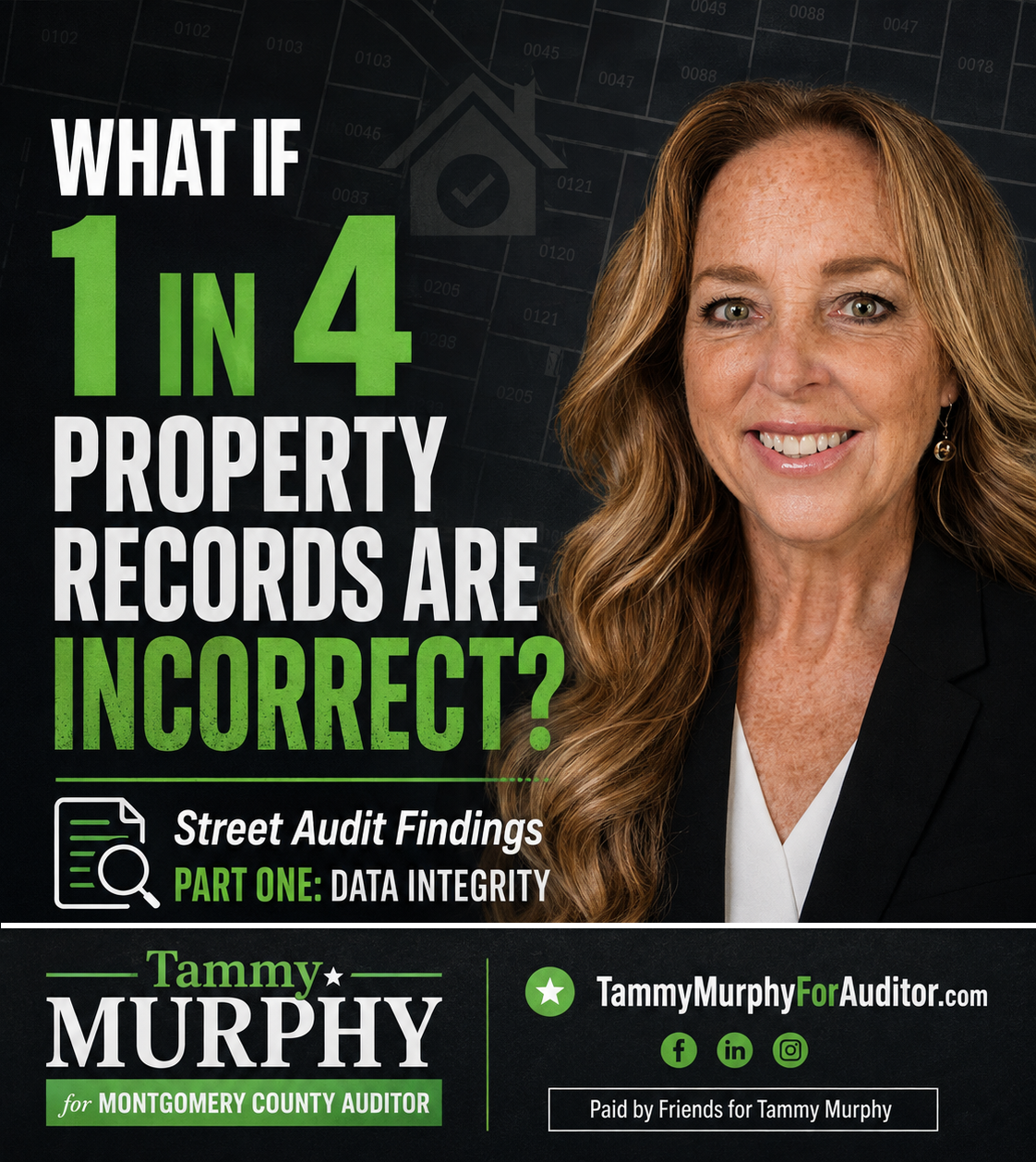
Are Montgomery County Property Records Accurate?
Can Montgomery County property owners trust the information in their public property records?
To find out, I reviewed the Auditor’s public property reports for every home on one street.
That street contains 46 homes.
I expected to find an occasional mistake. Instead, I found missing information, obvious errors, rental-registration concerns, and questions involving owner-occupancy credits.
These records matter. The Auditor’s Office relies on them to administer tax credits, describe each property, and support the valuation process.
I started with the County’s own public records
I reviewed the same information that any property owner can access through the Auditor’s website.
For each home, I checked:
- Parcel acreage
- Property type and style
- Square footage
- Bedrooms and bathrooms
- Owner mailing address
- Rental-registration information
- Owner-occupancy credits
This first review did not focus on whether the County assigned the correct value to each home.
I first wanted to know whether the underlying property records were accurate.
A valuation system cannot produce reliable results when it starts with incorrect or incomplete information.
Six single-family homes show zero acreage
One of the clearest problems involved lot size.
The public records list six conventional single-family homes as having zero acres.
These homes are not condominiums. Each one sits on an individual residential lot.
The smallest known lot on the street measures approximately .3673 acres, yet the Auditor’s public reports show no acreage for these six homes.
Lot size represents one of the most basic property characteristics. The system should catch a zero-acre entry for a conventional single-family home before a resident conducts a street-by-street audit.
That raises an important question:
If the public property record shows no acreage, what land information did the County use when it reviewed and valued the property?
Several apparent rentals do not appear in the rental records
The owner’s mailing address can also signal that a property may not serve as the owner’s primary residence.
During my review, I found several homes where the County sends the tax bill to a different address. Neighbors also confirmed that some of these homes have operated as rentals.
However, I could not find those properties in the rental-registration information I reviewed.
After I shared my initial findings with a group of neighbors, they identified another long-term rental. The property report also shows a different mailing address for the tax bill, but the rental-registration records do not appear to include the property.
A different mailing address alone does not prove rental use. However, that difference should trigger a review when other available information also points to rental occupancy.
The Auditor’s Office should maintain current, consistent, and easily verified rental records.
The owner-occupancy credits also raise questions
I also found concerns involving the Owner-Occupancy Credit.
One apparent rental receives the credit, while three actual owner-occupied homes appear to lack it.
The Owner-Occupancy Credit differs from the Non-Business Credit. The Non-Business Credit may apply to qualifying residential property, including rental property. Therefore, I am not treating a Non-Business Credit as an error simply because a property operates as a rental.
The real issue centers on the Owner-Occupancy Credit.
The system should apply that credit to the owner’s primary residence and remove it when the owner no longer occupies the home.
A reliable system should automatically flag:
- A property that receives an Owner-Occupancy Credit while the County sends the tax bill elsewhere
- A likely rental that lacks rental registration
- An owner-occupied home that does not receive the credit
- A conventional single-family home that shows zero acreage
These concerns involve basic data integrity, not complex appraisal disagreements.
These findings go beyond one clerical mistake
This one-street audit uncovered several categories of concern:
- Missing parcel acreage
- Apparent rental-registration gaps
- A questionable Owner-Occupancy Credit
- Actual homeowners who may lack the credit
- Public records that do not fully match the properties
I continue to verify the precise number of affected homes as neighbors provide additional information.
Even so, the initial findings already show a broader pattern.
That pattern raises a larger question:
How often does the Auditor’s Office proactively review property records for obvious errors before those records affect tax credits and property values?
Data integrity must come first
The Montgomery County Auditor manages an enormous amount of property information. No system will operate perfectly at all times.
However, the office should catch obvious errors through routine safeguards.
A stronger system could automatically flag:
- Zero-acre entries for conventional single-family homes
- Mailing addresses that differ from the property address
- Owner-Occupancy Credits connected to likely non-owner-occupied properties
- Missing rental registrations
- Owner-occupied homes that may qualify for a credit but do not receive it
- Conflicting or incomplete property characteristics
Those flags should then prompt human review and outreach.
That is what active oversight should look like.
Watch Part 1: One Street. One Audit. One Big Problem.
In this first Property Tax Corner episode, I walk through the public property records and explain the inaccuracies, missing information, and credit concerns I found on one street.
This episode focuses only on the foundation of the system:
Data integrity.
Before property owners can trust a value, they must first trust the property record behind it.
Review your own property record
Every Montgomery County property owner should review the public report for their home.
Ask:
- Does the record show the correct acreage?
- Does it list the correct property style?
- Does it show the correct square footage?
- Does it list the correct bedrooms and bathrooms?
- Does it show the correct mailing address?
- Does it properly identify the property as a rental, when applicable?
- Does it correctly apply the Owner-Occupancy Credit?
An error does not automatically prove that the County assigned the wrong value.
However, the County should correct inaccurate records quickly and clearly explain the process to the homeowner.
Accuracy is not optional
This audit covered only 46 homes.
Yet it uncovered enough missing and incorrect information to justify serious questions about the safeguards currently in place.
The Auditor’s Office should do more than store property data.
It should verify that data, flag obvious discrepancies, correct errors promptly, and clearly explain the correction process to the public.
Accuracy is not optional. Accountability starts with the records.