
Budget vs Actual Revenue
The Montgomery County property tax system is designed to estimate revenue, set a budget, and fund services for residents. Each year, officials establish expected property tax collections before the year begins.
However, when we compare those projections to actual results, a clear pattern emerges.
Year after year, more revenue comes in than originally planned.
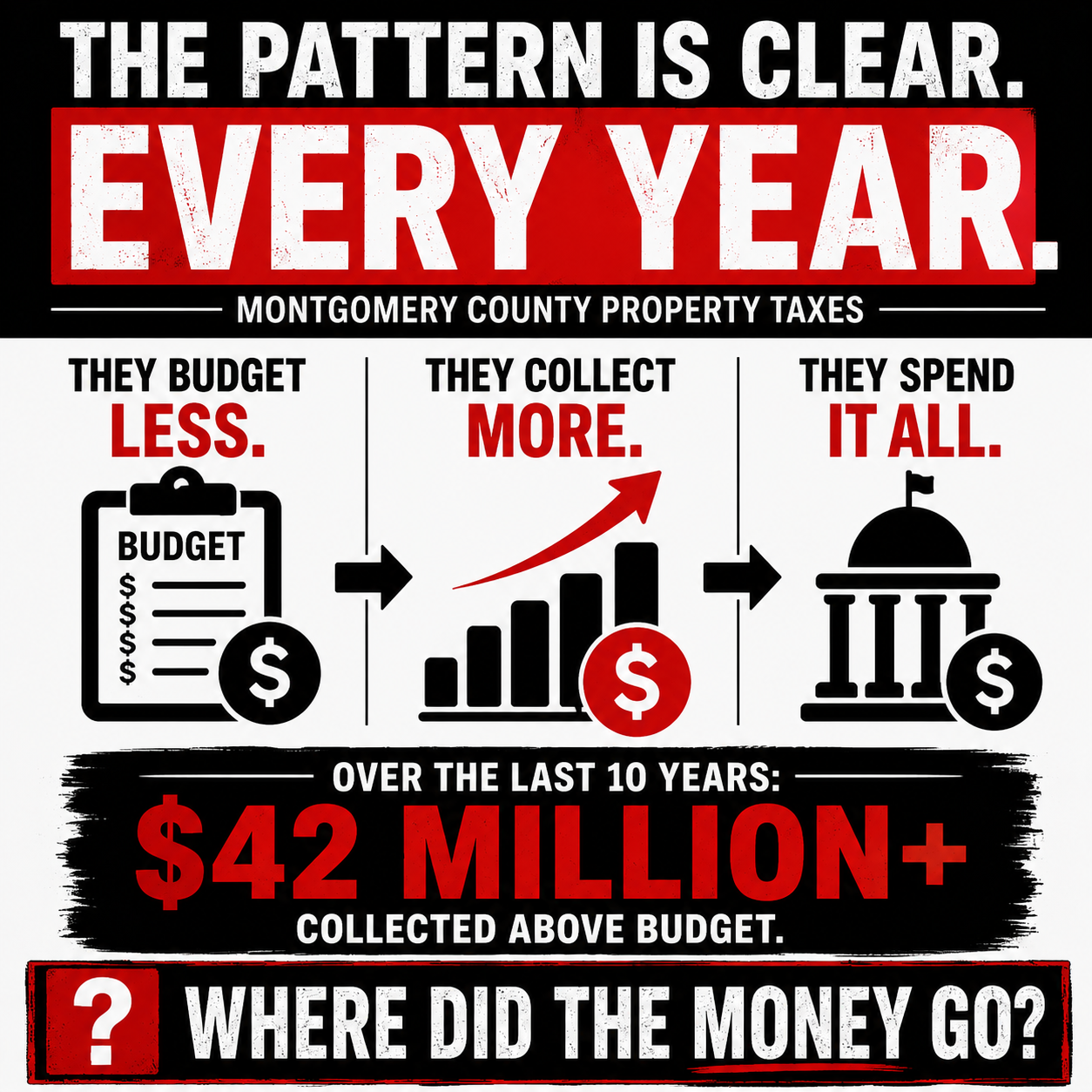
Over the past decade alone, property tax collections have exceeded budget estimates by more than $40 million. In 2025, that gap reached its highest level yet, with more than $6.5 million collected above projections.
The Data Behind the Pattern
The following table shows budgeted property tax revenue compared to actual collections:
| Year | Budgeted Property Tax | Actual Collected | Difference ($) | Difference (%) |
|---|---|---|---|---|
| 2015 | ~$110.0M | $114.42M | +$4.4M | +4.0% |
| 2016 | ~$124.0M | $128.42M | +$4.4M | +3.5% |
| 2017 | ~$125.0M | $129.22M | +$4.2M | +3.4% |
| 2018 | ~$127.5M | $130.96M | +$3.5M | +2.7% |
| 2019 | ~$130.0M | $134.32M | +$4.3M | +3.3% |
| 2020 | ~$132.0M | $136.29M | +$4.3M | +3.2% |
| 2021 | ~$132.5M | $135.07M | +$2.6M | +2.0% |
| 2022 | ~$130.0M | $132.08M | +$2.1M | +1.6% |
| 2023 | ~$130.5M | $133.27M | +$2.8M | +2.1% |
| 2024 | ~$135.0M | $139.47M | +$4.5M | +3.3% |
| 2025 | ~$140.0M | ~$146.5M+ | +$6.5M+ | ~+4.5% |
This is not a one-time occurrence. Every year in this dataset shows property tax collections exceeding projections.
If Costs Were Driving This, Budgets Would Show It
Many people assume higher tax collections reflect rising costs of services. That explanation sounds reasonable at first. However, the numbers tell a different story.
If increasing costs truly drove higher tax collections, then budgets would reflect that need upfront. Instead, the opposite happens.
Budgets consistently project lower revenue. Then, as the year progresses, actual collections come in higher than expected. Afterward, spending adjusts to match the available funds.
This pattern raises an important point.
Growth in spending does not always begin with need. In many cases, it follows available revenue.
How the System Functions in Practice
When we step back and follow the process, the cycle becomes easier to understand:
- First, a budget is created using estimated property tax revenue
- Next, actual collections exceed those estimates
- Then, additional funds become available during the year
- Finally, spending increases over time to use those funds
This sequence repeats consistently.
As a result, the system does not simply respond to demand. Instead, it expands as revenue allows.
A Decade of Over-Collection
Looking at the last ten years provides important context:
- Every year shows property tax collections exceeding projections
- The total difference now exceeds $40 million
- The annual gap has grown, with 2025 marking the highest level
Because this pattern holds across multiple years, it cannot be dismissed as a one-time occurrence.
It reflects how the current system operates.
What This Means for Fiscal Responsibility
Responsible financial management requires more than collecting revenue and funding operations. It also requires asking whether the system itself aligns with the needs of the people it serves.
When revenue consistently exceeds projections, several questions follow:
- Should those estimates be more accurate?
- Should excess funds be directed into reserves?
- Should taxpayers see relief when collections exceed expectations?
At a minimum, residents deserve clear answers.
Accountability Is Part of the Role
When the same outcome repeats year after year, responsibility does not disappear.
It falls on the person elected to protect taxpayers and ensure their money is handled responsibly.
That responsibility includes:
- Asking harder questions about projections
- Evaluating how excess funds are used
- Ensuring transparency in how money flows through the system
Without that level of oversight, the process continues unchanged.
Final Thought
The Montgomery County property tax system is not broken in the traditional sense. It functions exactly as designed.
However, the results show a system that grows as revenue increases, rather than one that actively manages and questions that growth.
Residents deserve more than a system that simply continues year after year.
They deserve clarity, accountability, and confidence that their money is being managed with intention.
Understanding the system is the first step. Improving it is the next.