
What I Found and Why Transparency Matters
In a previous post, I introduced Ohio Checkbook and discussed the importance of making public information easier for taxpayers to access and understand.
This week, I decided to take a closer look at what information is actually available throughout Montgomery County.
What I found was encouraging.
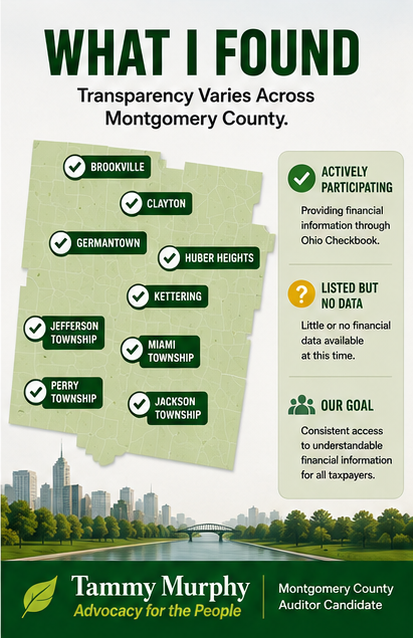
Several local governments and school districts are already participating in Ohio Checkbook and providing residents with access to financial information online.
Communities Leading the Way
The following communities currently participate in Ohio Checkbook:
Cities and Townships
- Brookville
- Clayton
- Germantown
- Huber Heights
- Kettering
- Jefferson Township
- Miami Township
- German Township
- Perry Township
- Jackson Township
School Districts
- Mad River Local Schools
- Miamisburg City Schools
- Perry Local Schools
- Trotwood-Madison City Schools
These communities deserve recognition for embracing tools that help make government information more accessible to the public.
Transparency is not always easy.
It requires systems, processes, and a commitment to making information available in ways that residents can actually use.
Why Does This Matter?
Some may ask why Ohio Checkbook matters at all.
After all, budgets, audits, and financial reports already exist.
The answer is accessibility.
Most residents are not going to search through hundreds of pages of financial reports.
However, they may want answers to practical questions:
- Where are public dollars being spent?
- What vendors provide services?
- How are taxpayer funds being allocated?
- How can I better understand local government finances?
Ohio Checkbook was designed to help bridge that gap.
Rather than requiring citizens to navigate complex financial documents, it creates another pathway to public information.
Transparency Builds Public Trust
When information is easy to find, public confidence grows.
Likewise, when information is difficult to locate, residents often become frustrated and disconnected from the process.
Transparency should not be viewed as a burden.
Instead, it should be viewed as a public service.
The more accessible government information becomes, the more informed citizens can be.
In turn, informed citizens are better equipped to participate in discussions about budgets, priorities, levies, and community investments.
Why County Leadership Matters
One of the reasons I believe this discussion is important is because county government often sets the tone for public expectations.
The Montgomery County Auditor serves as the county’s chief fiscal oversight official and maintains many of the records taxpayers rely upon every day.
While the Auditor cannot force every city, township, or school district to adopt a particular transparency tool, the office can lead by example.
Leadership matters.
When county government embraces transparency, accessibility, and modernization, it encourages other public entities to do the same.
The goal should not be compliance.
The goal should be service.
Taxpayers deserve information that is easy to find, easy to understand, and available when they need it.
Looking Ahead
As I continued reviewing Ohio Checkbook, I discovered something equally interesting.
Several communities and public entities are listed within the system but currently show little or no available financial information.
That raises another important question:
Should taxpayers have a consistent experience accessing public financial information regardless of where they live?
In my next article, I will take a closer look at those findings and explore what taxpayers should reasonably expect from modern transparency tools.
Because transparency is not simply about making information public.
It is about making information accessible.
And accessibility builds trust.