
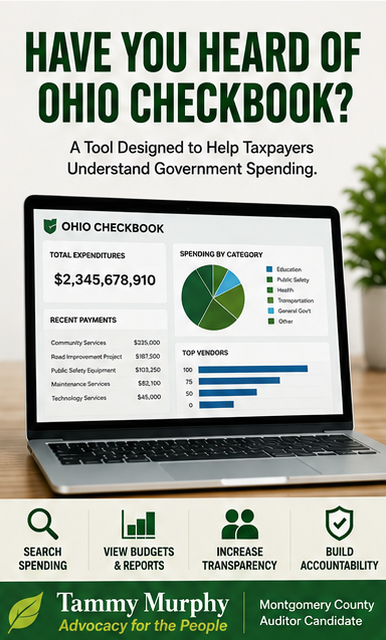
Can Taxpayers Easily Find Public Spending Information?
Every year, Montgomery County residents pay property taxes that help fund schools, public safety, libraries, parks, road maintenance, county services, and local government operations.
Most taxpayers understand that these services require funding. However, many residents struggle to answer a simple question:
Where does the money actually go?
As I have attended city council meetings, township trustee meetings, school board meetings, and community events across Montgomery County, I have heard concerns from residents who want a better understanding of how public dollars are being spent.
The challenge is not necessarily that information doesn’t exist.
Instead, the challenge is accessibility.
Many financial reports are available through budgets, annual reports, audits, meeting minutes, and various government websites. While these documents are important, they can be difficult for the average resident to locate, navigate, and interpret.
As a result, accessibility becomes just as important as transparency.
This led me to explore a tool called Ohio Checkbook.
What Is Ohio Checkbook?
Ohio Checkbook was created to improve transparency by allowing citizens to view government spending information online. The concept is straightforward: taxpayers should have an easier way to see how public funds are being spent.
The goal is not to create suspicion.
Rather, the goal is to create understanding.
When residents can easily access information about government finances, trust grows and communities become more engaged.
A Question Worth Exploring
As I began reviewing Ohio Checkbook, I quickly discovered that the concept is much easier to understand than the actual experience taxpayers encounter when trying to access information.
The tool was designed to make government spending more transparent and more accessible to the public.
That raises several important questions:
- How many local governments participate?
- Is the information easy to find?
- Is the information current?
- Can the average taxpayer understand what they are looking at?
- Does the experience differ depending on where they live?
Those questions led me to take a closer look at public transparency tools and the ways local governments share financial information with residents.
What I found deserves a deeper discussion than can be covered in a single article.
Over the coming weeks, I will explore how public information is shared throughout Montgomery County, what resources are available to taxpayers, and how technology can help make government information easier to access and understand.
Transparency Is About Trust
Transparency is not about assuming wrongdoing.
Instead, transparency is about trust.
When citizens can easily access information, confidence in government grows. As a result, residents become more informed, more engaged, and better equipped to participate in community conversations.
Most taxpayers are not looking to analyze complex accounting reports. Rather, they simply want answers to reasonable questions:
- Where are tax dollars being spent?
- What services are receiving funding?
- How are priorities being established?
- How can I understand the financial health of my community?
These are fair questions.
Furthermore, taxpayers deserve reasonable access to the information needed to answer them.
Making Public Information Easier to Understand
As technology continues to improve, governments have more opportunities than ever before to make information available in ways that are easy to access and easy to understand.
My vision is not simply greater transparency.
It is better accessibility.
Information should be available to citizens without requiring specialized financial knowledge, extensive research, or public records requests.
Government serves the people.
Therefore, the information generated by government should be understandable to the people it serves.
Looking Forward
This is the beginning of a broader conversation about Montgomery County government transparency, accessibility, modernization, and public trust.
In the coming weeks, I will continue exploring available resources, evaluating transparency tools, and identifying ways to improve public access to information.
Future discussions will include:
- How Ohio Checkbook works
- Where property tax dollars go after they are collected
- What transparency tools are available to taxpayers
- How technology can improve public access to information
- What residents should reasonably expect from government transparency efforts
An informed citizen is an empowered citizen.
And stronger communities begin with better access to information.