
For quite some time now, many homeowners across Ohio have been asking an important question:
If property taxes continue rising, where is all of the additional money going?
That conversation has often been dismissed, minimized, or redirected.
Yet now, lawmakers themselves are introducing new legislation that specifically addresses surplus funds and excess collections within portions of the property tax system.
That matters.
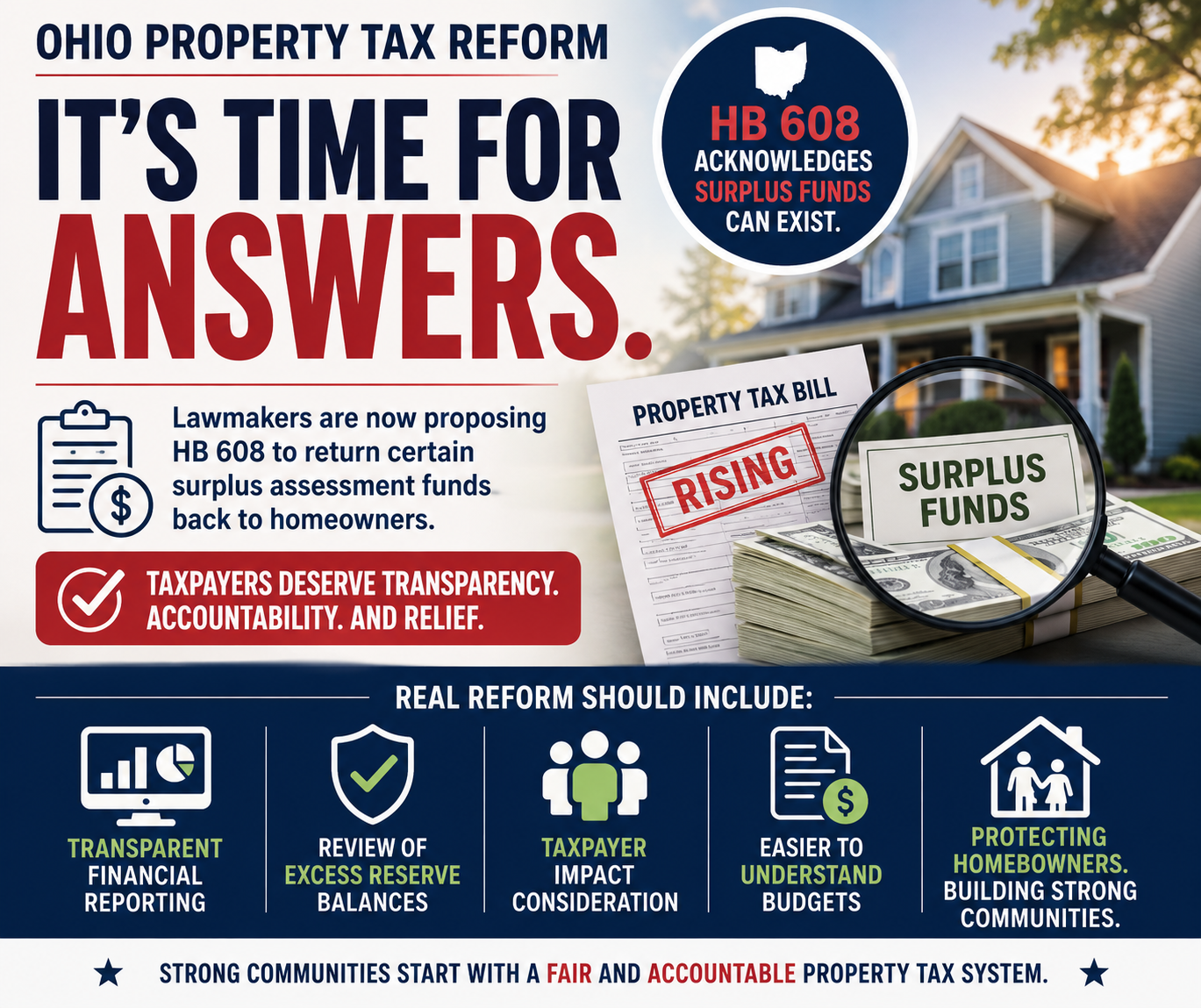
A recent Dayton Daily News article highlighted proposed House Bill 608, which would allow certain surplus Real Estate Assessment (REA) funds to potentially be returned directly to owner-occupied taxpayers as credits.
Whether the bill ultimately passes is not the only issue.
The bigger takeaway is this:
Ohio legislators are now openly acknowledging that overages and surplus balances can exist within the system.
That is exactly why taxpayers have been demanding more transparency and accountability.
HB 608 Changes the Conversation
For years, many residents have felt frustrated by the idea that questioning rising property taxes automatically meant opposing schools, public safety, or local services.
That was never the point.
The real concern has always been whether the system is properly balancing:
- government revenue growth,
- reserve balances,
- and the financial realities homeowners are facing every day.
HB 608 moves that conversation into the open.
According to the Dayton Daily News report, lawmakers described the proposal as an effort to address frustrations taxpayers have voiced regarding property tax collections and surplus assessment funds.
That is a significant shift.
Because it shows taxpayer concerns are no longer being ignored at the state level.
Montgomery County’s Own Numbers Raise Questions
The article also referenced Montgomery County previously redistributing approximately:
$5 million
in surplus REA funds following the 2020 revaluation cycle.
That confirmation is important because it demonstrates:
- excess balances can accumulate,
- collections can exceed operational needs,
- and surplus discussions are legitimate public policy conversations.
Current Montgomery County Auditor Karl Keith stated in the article that homeowner credits under the proposed bill would likely be relatively small and difficult to distribute fairly under the current structure.
While those operational concerns may be valid within the existing framework, many taxpayers are increasingly asking a larger question:
Should leadership simply defend the current system, or should it actively explore modernization and taxpayer-focused improvements?
That is where the conversation needs to go next.
Families Have Already Been Forced to Adjust
Homeowners throughout Ohio have spent the last several years adapting to:
- inflation,
- higher utility costs,
- rising insurance premiums,
- increased grocery prices,
- and growing financial pressure.
Many families have:
- depleted savings,
- delayed home repairs,
- reduced spending,
- or relied on credit cards for unexpected expenses.
At the same time, rising property valuations have increased property tax revenues throughout many parts of Ohio.
That reality is why residents are demanding more visibility into:
- reserve balances,
- surplus funds,
- administrative costs,
- and long-term financial planning.
People are not asking for chaos.
They are asking for transparency and balance.
Real Ohio Property Tax Reform Must Focus on Accountability
Ohio property tax reform should not be driven by fear or political extremes.
Strong communities absolutely require:
- quality schools,
- public safety,
- fire and EMS services,
- parks,
- libraries,
- and responsible local government.
But protecting communities also means protecting the homeowners funding those systems.
Real reform discussions should include:
Transparent Financial Reporting
Taxpayers should easily understand:
- how much revenue is collected,
- where the money goes,
- current reserve balances,
- and year-over-year growth trends.
Easier-to-Understand Public Budgets
Government reporting should be clear enough for ordinary residents to follow without needing accounting expertise.
Review of Excess Reserve Balances
When balances significantly exceed operational needs, there should be:
- public review,
- financial discussion,
- and taxpayer visibility before pursuing additional revenue increases.
Taxpayer Impact Consideration
Financial decisions should account for:
- affordability,
- fixed-income residents,
- inflation pressures,
- and long-term housing stability.
The Conversation Is Finally Starting
HB 608 may not solve every issue within Ohio’s property tax system.
However, it does prove something important:
The concerns homeowners have been raising are real enough that lawmakers are now responding publicly.
That alone signals the conversation is changing.
The next step should not be defending outdated systems simply because they already exist.
The next step should be building a modern, transparent, taxpayer-focused approach that restores public trust while protecting both essential services and long-term homeownership affordability.
Because taxpayers deserve more than being told:
“That’s just how the system works.”
They deserve leadership willing to ask whether the system can work better.