
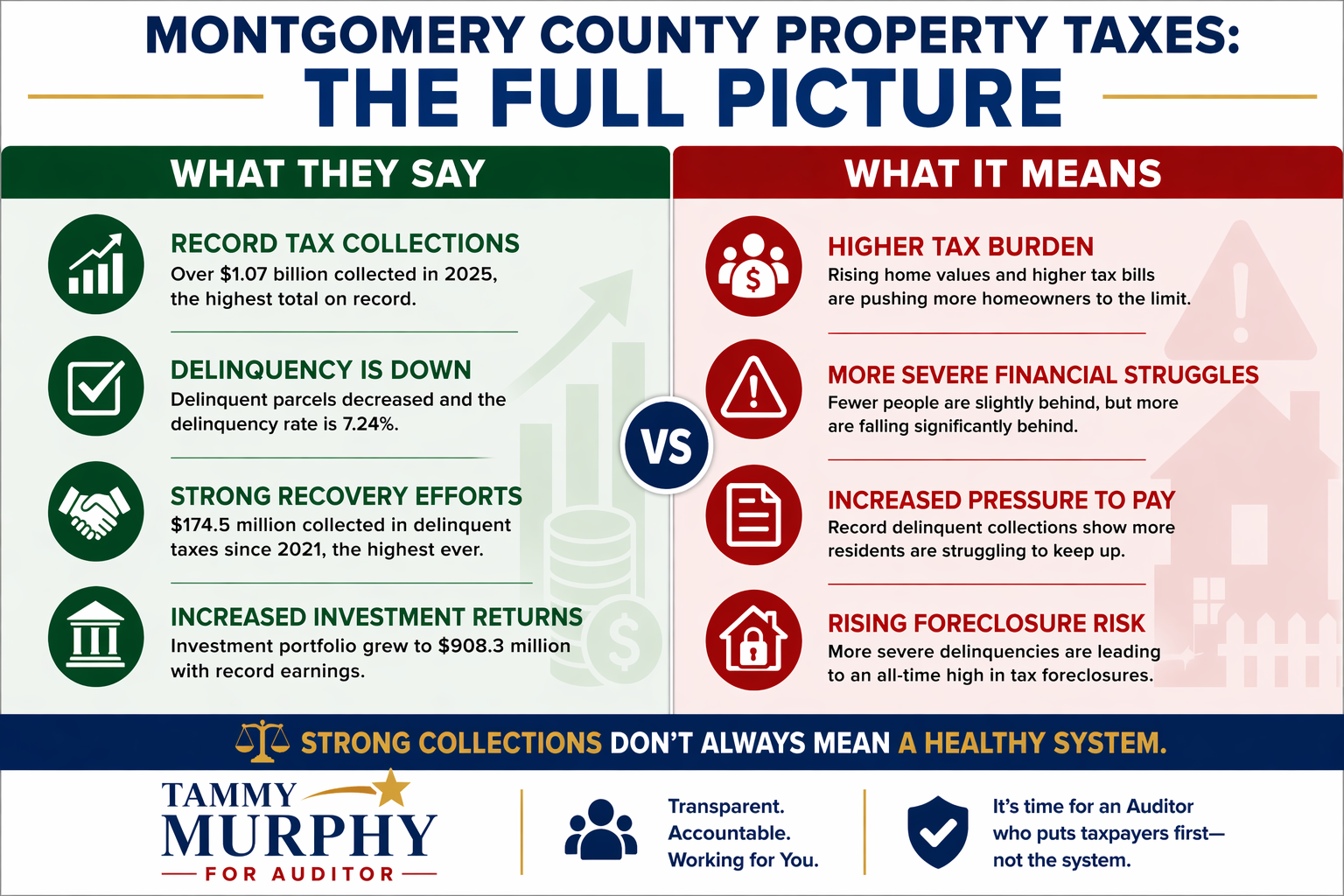
The County Treasurer Annual Report for 2025 is drawing attention across Montgomery County, highlighting record property tax collections, declining delinquency rates, and growing concerns around foreclosure activity.
While the report presents a strong financial picture at first glance, it is important to take a closer look at what these numbers truly represent for homeowners. If you want to review the full report yourself, you can access the public document here: CLICK HERE.
So what is really happening behind the numbers?
A Record Year for Property Tax Collections
According to the Treasurer’s 2025 report, Montgomery County collected over $1.07 billion in property taxes, the highest total on record.
That sounds like a success.
However, this increase is not happening in a vacuum. Higher collections are largely driven by:
- Increased property valuations
- Rising tax bills for homeowners
- More aggressive collection efforts
While the system is clearly effective at collecting revenue, it does not necessarily reflect how manageable those taxes are for residents.
Delinquency Is Down—But That’s Not the Full Story
The report highlights a decrease in delinquent parcels and a current delinquency rate of approximately 7.24%.
That statistic is being presented as progress—and in some ways, it is.
However, there is an important distinction:
- Fewer people are slightly behind
- More people are falling significantly behind
This shift matters.
When smaller delinquencies are resolved through payment plans or collections, what remains are the more serious cases—often those that lead to foreclosure.
Record Delinquent Tax Collections Raise Questions
One of the most important data points in the report is this:
- $174.5 million collected in delinquent taxes since 2021
This is the highest amount ever collected.
While it demonstrates efficiency, it also raises a critical question:
👉 Why are so many residents falling behind in the first place?
Strong collections do not necessarily mean a healthy system—they can also indicate increasing financial pressure on taxpayers.
Rising Refunds Signal Instability
Another overlooked detail is the significant increase in property tax refunds:
- Over $9 million refunded in 2025
- A 55% increase from the prior year
- Nearly 182% increase since 2019
Refunds often result from:
- Overpayments
- Adjustments in property valuations
- Successful appeals
This trend suggests there may be inconsistencies or timing issues in how property values—and therefore tax bills—are being determined.
Why Foreclosures Can Be Rising at the Same Time
Recent reports indicate that foreclosures tied to unpaid property taxes are increasing.
At first, this seems to contradict the Treasurer’s report.
In reality, both can be true.
Here’s why:
- Payment plans and collections resolve smaller delinquencies
- Larger, unresolved debts move toward foreclosure
- Rising tax bills increase the likelihood of severe delinquency
In simple terms:
👉 The system is improving collections—but not preventing hardship.
What This Means for Montgomery County Homeowners
When you step back and look at the full picture, a clear pattern emerges:
- Property tax collections are at record highs
- Delinquent collections are also at record highs
- Refunds are increasing significantly
- Foreclosures are becoming more common
These trends point to a system that is functioning—but under strain.
What Needs to Change Moving Forward
The role of the County Auditor is not just to maintain records—but to ensure the system works for the people it serves.
That means:
- Clear and transparent property valuations
- Better communication before tax issues escalate
- Modernized systems that provide real-time information
- A focus on prevention—not just collection
Because at the end of the day, property taxes should be understandable, predictable, and fair.
Final Thought
The Treasurer’s report tells us how well the system collects money.
But the real question is:
👉 Is the system working for the people paying it?
That’s where the conversation needs to shift.